
Compared to skulls, cleaning whole skeletons is a much bigger task. As well as having many small vertebrae in the spinal column, you will also find very thin ribs, and very small toes. You may be surprised by how complex and challenging it is!
Maybe it’s a teacher building a classroom display. Maybe it’s an artist, or a hobbyist with a bird found on a walk. If that person is looking at Kodiak’s dermestid beetles for bone cleaning, the beetles are the easy part. It can be harder to preserve the whole skeleton. However, if you do things correctly you will get a nice museum style result.
Small bones
It can be difficult to clean small skeletons with boiling methods. Bones can become detached in hot water, and very small bones may be lost. Scrubbing can break thin rib bones.
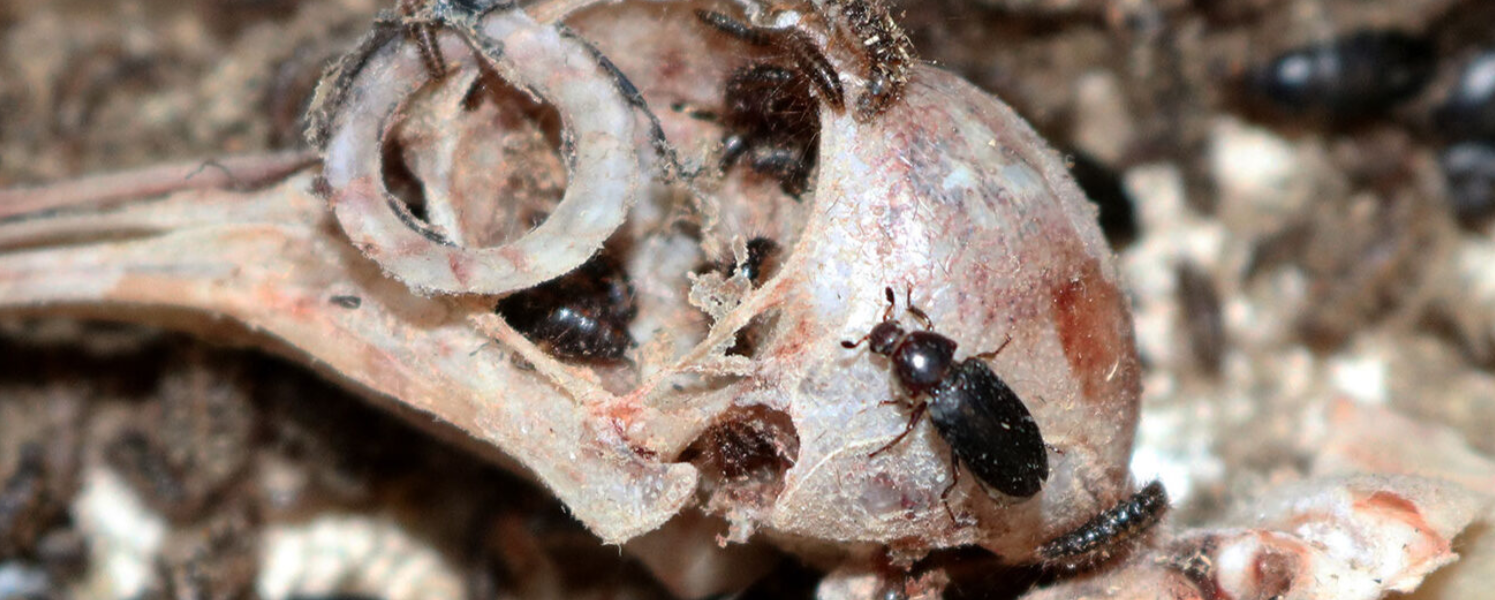
Dermestid beetle larvae have soft bodies and are very small. As such, they can get into narrow places that a tool cannot. They will remove any desiccated flesh while leaving the bones intact. As a result, they have been used in museums for many years.
Whole skeleton or individual bones?
This decision should be made early on. Depending on what you want to achieve, you may wish to have individual bones, or a whole skeleton.
Individual bones are easier. It does not matter if the bones are detached. If you want to keep bones in a skeletal shape, it will require more patience. As the tissue is digested by the beetles, the tissues which are holding the bones together in place will be removed. Therefore, if left in too long, bones may fall apart. However, if removed too early, some meat will still be left on the bones.
Both options are correct, depending on what you want to achieve.
Preparing the body
Dermestid beetles work best on dessicated tissue. For this reason, the animal should be skinned, gutted and large muscles removed. The remaining body should be dried until it becomes leathery.
If the body is fresh and wet, it will smell very badly and attract flies. This is not ideal in spare rooms. If the body was frozen, be sure to allow it to thaw completely. It can be useful to freeze bodies to store them for future beetle cleaning.
Tiny bones may be lost
If you put a dried chipmunk in the beetle box, and leave it for a week, you may find that some bones have been lost! For example, some toes, and a few ribs may be missing. Some bones
may be hidden in the crumpled paper, and a few may have been taken by the beetles. If you leave the chipmunk in the beetle box for hours, you may find yourself using tweezers to search through card.
To avoid losing bones, place the body in a shallow dish/basket. This will mean that bones are less likely to be lost. At the end you can also easily count how many bones you have.
Housing
Using a sealed plastic container is fine. For good ventilation, make a hole in the lid with fine mesh. Place some crumpled paper in the bottom for the larvae. Smooth sides are best to allow adult beetles to crawl up and fly around.
Keeping them warm will encourage activity. Most people try to keep them at around 75-85 degrees (24-29°c). If it is too cold, their activity will decrease. It is best to keep the environment dark and fairly dry to prevent moulds and mites growing from damp.
Try to keep the container away from any fur, feathers, wool or stored food items. Close relatives of these beetles can chew through these materials.
Summary
Cleaning whole skeletons takes a bit longer and requires more attention than skulls. However, seeing lots of small bones come out clean and white can be very satisfying!
Count those toes!